
Introduction: The Rise of Intelligent Locking Solutions
The logistics and transportation industry is undergoing a profound transformation. With the increasing demand for real-time cargo visibility, heightened cross-border supply chain security requirements, and the accelerated commercialization of satellite navigation systems, GPS padlocks have emerged as a critical intelligent device that integrates satellite positioning, remote communication, and security locking functions. These devices are rapidly evolving from simple electronic upgrades of traditional mechanical locks into essential terminal equipment for logistics and asset visibility management.
According to industry research reports, the global GPS padlock market has demonstrated strong growth momentum in recent years and is projected to maintain a compound annual growth rate of over 12% from 2026 to 2032. This sector is showing significant growth potential within the smart lock and IoT terminal segments, with China emerging as the world's largest consumer and production market.
What Is a GPS Padlock? Definition and Industry Value
Traditional padlocks have long suffered from weak anti-theft capabilities, non-traceable movement history, and low management efficiency. GPS padlocks were developed to address these pain points. By integrating satellite positioning, remote communication, and security locking functions, GPS padlocks have evolved into a comprehensive product system featuring dual-mode positioning and multi-scenario adaptability. They are now widely used in logistics transportation, asset management, public security, and civilian security applications.
The core value of GPS padlocks lies in upgrading traditional mechanical locks from simple physical protection to integrated management capabilities that include:
Real-time location tracking
Remote monitoring
Status sensing and alerting
This transformation enables businesses to monitor cargo locations, lock status, and transportation conditions in real time, effectively reducing cargo loss risks and unauthorized behaviors during transit.
Product Types and Application Scenarios
By product type, the GPS padlock market is divided into four main categories: rigid shackle, flexible steel cable, magnetic steel cable, and others
Rigid shackle GPS padlocks currently hold the largest market share and are primarily used in container logistics and truck/trailer transport, offering high strength and strong resistance to damage — ideal for high-security transportation scenarios.
Flexible steel cable and magnetic steel cable GPS padlocks offer greater flexibility and adaptability for binding various cargo shapes and facilities, making them suitable for a wider range of applications.
Jlinkiot offers a comprehensive GPS padlock solution that covers both rigid shackle and flexible cable designs. Our logistics locks are engineered with dual-mode GPS/BeiDou positioning, 4G communication, and ultra-long battery life, making them ideal for container tracking, truck fleet management, and cross-border cargo security. Whether you need high-strength rigid shackle locks for heavy-duty shipping or flexible cable locks for versatile cargo binding, Jlinkiot provides reliable, customizable solutions tailored to your logistics needs.
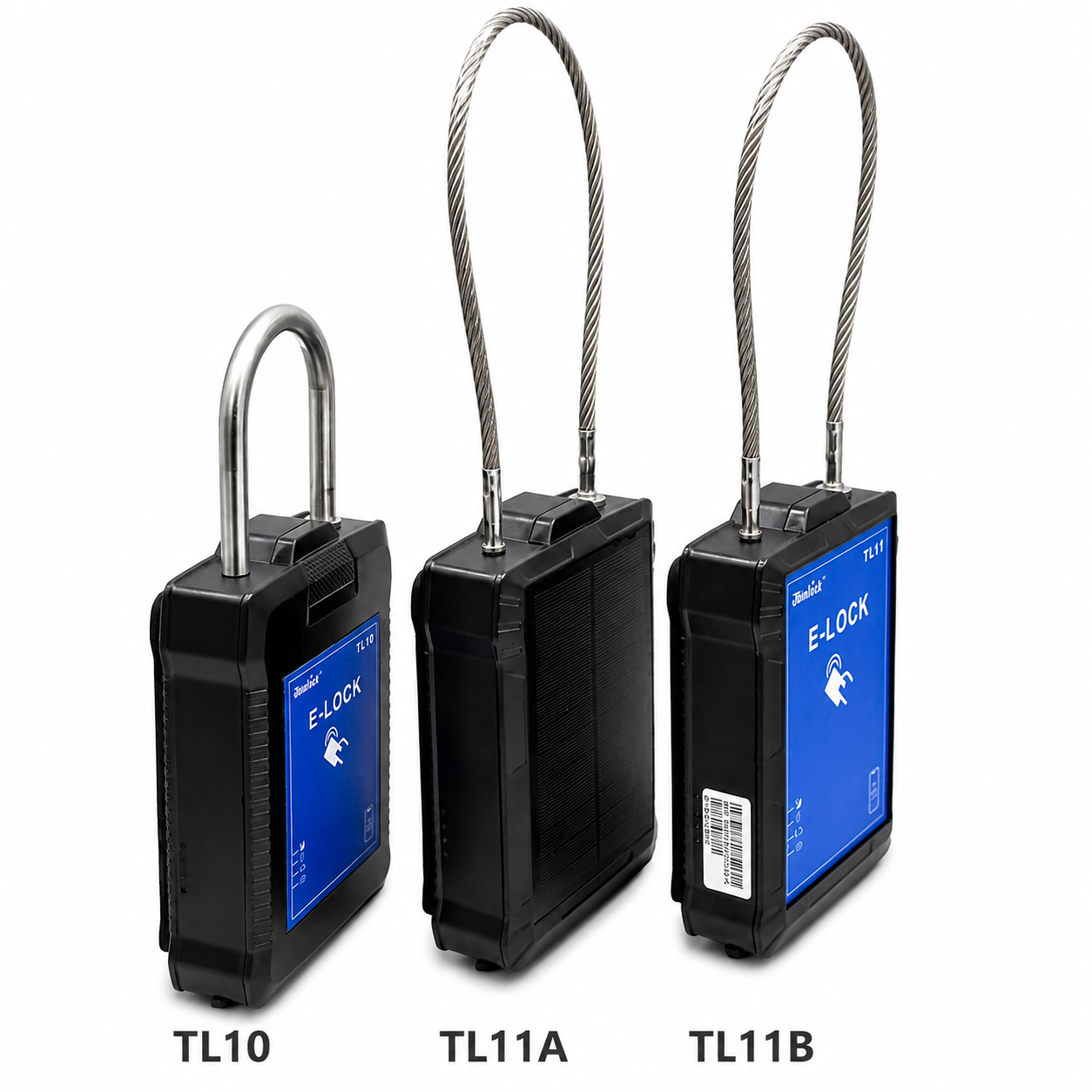
By application, container logistics is one of the largest markets for GPS padlocks, with significant growth expected in the coming years. In container transport, GPS padlocks are replacing traditional lead seals to enable visualized monitoring of the entire shipping process, effectively preventing driver misconduct and significantly reducing cargo loss rates. Truck/trailer logistics, tanker transport, warehousing management, bike-sharing, and home asset protection are also important and emerging application areas.
Industry Chain and Market Landscape
Upstream supply chain for GPS padlocks includes
Base materials (engineering plastics and color masterbatches)
Key components (GPS/BeiDou modules, 4G communication chips, sensors)
Technical support (high-precision electronic maps, IoT cloud platforms, precision manufacturing equipment)
Midstream manufacturing is concentrated in the Pearl River Delta region, where manufacturers handle lock structure design, electronic module integration, firmware development, final assembly, and platform integration.
Downstream applications are distributed across logistics and transportation, public security, and civilian markets. The logistics and transportation sector represents the largest share, with tobacco and cross-border e-commerce as core scenarios. Public security applications focus on emergency supplies management, while the civilian market covers bike-sharing and personal asset protection, with household adoption growing rapidly year over year.
From a production perspective, China is the world's leading manufacturing region for GPS padlocks, accounting for a dominant share of global production. This dominance is driven by China's well-established electronics manufacturing supply chain, the mature smart hardware industrial cluster in the Pearl River Delta, and the rapid growth in demand driven by logistics intelligence upgrades.
The global GPS padlock market presents a highly concentrated competitive landscape, with the majority of core manufacturers concentrated in the Pearl River Delta and Shenzhen region.
Technology Trends Shaping the Future
The GPS padlock industry is evolving toward
Higher positioning accuracy – BeiDou-compatible product penetration is increasing rapidly, with China accelerating the transition from GPS-only to BeiDou/GPS dual-mode positioning to enhance accuracy and autonomous control.
Extended battery life – Solar-powered models are gaining market share, achieving standby times exceeding 12 months.
Multi-sensor integration – A growing number of high-end models now integrate temperature, humidity, and vibration sensors for combined positioning and status monitoring.
Cloud platform integration – Advanced communication technologies are reducing remote unlocking response time significantly. AI algorithms can predict abnormal behaviors like forced entry and trigger instant alerts. IoT platforms support synchronized management of thousands of devices, reducing operational costs.
Jlinkiot stays at the forefront of these technological trends. Our GPS padlocks feature BeiDou/GPS dual-mode positioning for enhanced accuracy and reliability. We offer solar-powered models with extended battery life, optional temperature/humidity sensors for sensitive cargo monitoring, and seamless integration with our cloud-based management platform. Our devices support remote unlocking via web or mobile, real-time status updates, and advanced security features — all designed to meet the evolving needs of modern logistics. We also provide flexible customization services, allowing clients to tailor features such as reporting frequency, sensor configurations, and platform integration according to their specific requirements.

Regional Market Dynamics
China is the world's largest GPS padlock consumer market, holding a significant share of the global market. China's market leadership is driven by logistics intelligence upgrades, government policy support for BeiDou industrialization, and the supply capabilities of the Pearl River Delta smart hardware industrial cluster.
Europe and North America are also important markets, maintaining stable growth in logistics security and asset tracking demand. In the coming years, China is expected to maintain the fastest growth rate, driven by cross-border logistics security requirements and the replacement demand of domestic logistics enterprises for old locks. The Southeast Asian and Middle Eastern markets are growing rapidly, and the Asia-Pacific region will become increasingly important in the global GPS padlock market.
Market Drivers and Industry Trends
Key growth drivers include:
Rigid demand for cargo visibility – Traditional lead seals are increasingly recognized for their shortcomings in tamper resistance, traceability, and real-time monitoring, driving GPS padlocks from optional upgrades to industry standards.
BeiDou industrialization acceleration – National policies have clearly defined BeiDou industrialization goals, with BeiDou-compatible product penetration increasing steadily year over year.
Cross-border logistics security – Southeast Asian and Middle Eastern markets are growing rapidly, creating significant export opportunities.
Replacement demand – Logistics companies worldwide are upgrading their old locking systems to smart solutions.
Policy drivers – Regulatory requirements in various regions are driving the adoption of smart locks for cross-border transportation.
Industry trends include:
Continued evolution toward higher positioning accuracy and multi-sensor integration
Growing adoption of solar-powered and ultra-long battery life solutions
Increasing integration with cloud platforms and AI-powered analytics
Expanding applications beyond logistics into civilian and asset protection market
Future Market Outlook
Looking ahead, the global GPS padlock market is expected to maintain strong growth. Key trends include:
Rigid shackle GPS padlocks will remain the largest product category
Container logistics will continue to be the largest application, with truck/trailer logistics, warehousing, and civilian scenarios contributing significant incremental demand
BeiDou-compatible products will continue to gain penetration
Solar-powered models and multi-sensor high-end products will gradually become mainstream configurations
China will remain the world's largest consumer market
Southeast Asia and the Middle East will become important incremental markets
Jlinkiot is well-positioned to capture this growing market opportunity. With our deep expertise in IoT R&D and manufacturing, we offer a complete range of GPS padlock solutions that meet the diverse needs of logistics companies, asset managers, and security professionals worldwide. Our products are designed with the latest technology, manufactured to the highest quality standards, and backed by responsive customer support. Whether you need standard models or customized solutions, Jlinkiot is your trusted partner for smart locking and asset tracking.

Conclusion
The growth of the GPS padlock market fundamentally reflects the logistics industry's transformation from "passive protection" to "active monitoring" management philosophy, as manifested in locking terminal devices. Traditional mechanical padlocks and lead seals can only provide physical protection and cannot address the management blind spots of non-traceable movement history and non-real-time status monitoring during transit.
By integrating satellite positioning, remote communication, and intelligent sensing technologies into lock devices, GPS padlocks upgrade locks from mere "access tools" to "asset management terminals," delivering irreplaceable value in logistics visibility management and transportation risk control.
As an experienced IoT solution provider, Jlinkiot is committed to driving this transformation forward, delivering innovative, reliable, and cost-effective intelligent locking solutions to customers worldwide.